Local vs. Offshore Website Agencies: Which One’s Right for Your Brand?
So, your brand needs a new website. Not just any website—a conversion-driving, SEO-dominating, jaw-droppingly beautiful digital experience. You’re ready to hire an agency, but now you’re stuck on a big decision: Do you go with a local U.S.-based agency, or do you hire a team in India to build it?
On one hand, you’ve got the comfort of working with a team in your own backyard. On the other, there’s a promise of cost savings (sometimes a LOT of savings) if you offshore the project.
Before you swipe that corporate card, let’s break down the real pros and cons of each option, so you don’t end up with a website that looks like it was built in 2007.
The Case for a U.S.-Based Agency
Pros: The Good Stuff
1. Seamless Communication & Collaboration
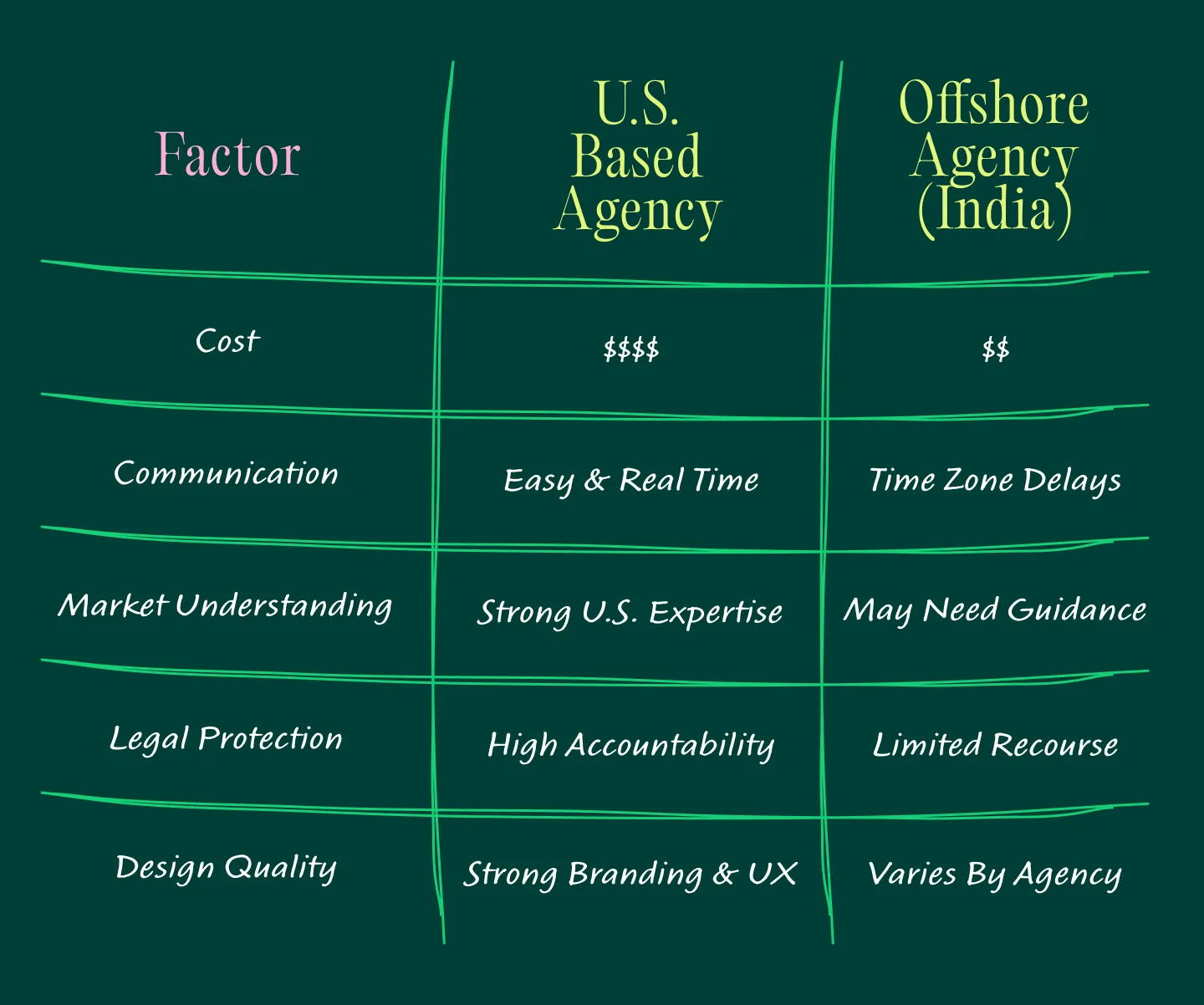
No weird time zones, no waking up at 5 a.m. to hop on a Zoom call. A U.S.-based agency works when you work, which means faster responses, smoother project management, and fewer email chains lost in translation.
Visual Idea: An image of two people discussing a website project over a laptop in a well-lit office, representing smooth collaboration.
2. They Get Your Audience
Your U.S. customers expect a certain level of UX, brand voice, and functionality that an American agency naturally understands. They also know compliance rules (hello, ADA and GDPR) that keep you from getting a nasty lawsuit.
3. Face-to-Face Meetings (If You’re Into That)
Sometimes, it’s just easier to meet in person, whiteboard out ideas, and make sure they understand your brand vision before a single line of code is written.
4. Higher Accountability & Legal Protection
If things go sideways, U.S.-based agencies are easier to hold accountable. Contracts are more enforceable, and there’s less risk of an agency ghosting you mid-project.
Cons: The Not-So-Good Stuff
1. Costs Can Be Brutal
Expect to pay anywhere from $10,000 to $100,000+ for a solid website. If you’re looking for premium branding and design, get ready to dip into that marketing budget.
2. Longer Turnaround Times
Because of structured workflows and multiple client projects, U.S. agencies may take longer—especially if you want pixel-perfect, UX-driven work.
3. No 24/7 Availability
Your website doesn’t sleep, but most U.S. agencies do. Unless you’re paying for an extended support package, you won’t get midnight bug fixes or instant updates.
The Case for an Indian-Based Agency
Pros: The Good Stuff
1. Major Cost Savings
An Indian agency can deliver a website for 50-70% less than a U.S. agency. We’re talking $3,000 to $25,000 for a high-quality site. If budget is your #1 priority, this is a serious advantage.
2. Faster Development Turnaround
With larger teams and around-the-clock workflows, many offshore agencies deliver projects faster than U.S. firms—especially if it’s a development-heavy site.
3. 24/7 Support
Since India is 10+ hours ahead of the U.S., you could send requests at night and wake up to progress. Some agencies even offer round-the-clock monitoring for peace of mind.
4. Strong Tech Expertise
India is a global leader in software development, meaning you’ll find plenty of agencies skilled in WordPress, Shopify, custom web apps, and even AI-driven website builds.
Cons: The Not-So-Good Stuff
1. Communication Can Be Tricky
The time zone gap means delayed feedback loops. If you need daily check-ins and rapid-fire revisions, this could get frustrating fast.
2. Varying Quality Levels
There are incredible agencies in India, and there are… let’s just say, some sketchy ones. You’ll need to vet portfolios, check reviews, and ask for a paid test project before committing.
3. Less Familiarity with U.S. Market Expectations
Some offshore agencies don’t fully grasp American branding, UX preferences, and SEO standards, which can result in a website that feels… off.
4. Potential Hidden Costs
Some offshore agencies quote rock-bottom prices, but then charge extra for revisions, support, or additional features. Read the fine print.
So, Which One’s Right for You?
Here’s the deal:
Go with a U.S. agency if you need high-end design, strong branding, seamless collaboration, and local expertise. If your brand thrives on premium storytelling and user experience, it’s worth the investment.
Go with an Indian agency if you’re on a budget, need a development-heavy site, and don’t mind some communication hurdles. You can get great work—just do your homework on who you’re hiring.
Hybrid Approach? Some companies use a U.S. agency for strategy and design, then outsource development offshore to save money. Best of both worlds? Maybe.
Whatever you choose, don’t just look at the price tag. Think about your brand’s needs, workflow preferences, and long-term website goals. Your website isn’t just a digital brochure—it’s your most important marketing asset. Choose wisely.
Need a second opinion before signing that agency contract? Hit me up—We’ve seen enough website disasters to know what to avoid.
Budgeting advice, trends, and predictions for media in 2018 and beyond
Everybody who uses a computer for a living wants to feel like Tom Cruise in Minority Report, especially this guy. While I can’t predict the future or arrest future murderers, I can illustrate some trends I’m seeing in the way marketers are investing their media dollars and assure you that yes, there will be billboards that know who you are in the future. You can use these trends to inform how you allocate that 2018 marketing budget you haven’t finished yet.
So what can we learn as marketers by looking at what media other marketers are investing in next year? A lot, actually.
In this post I’ll be referencing data from an eMarketer report titled US Total Media Ad Spending, 2008-2021. If you like numbers you can view a spreadsheet of the entire report, including comparative data from other sources, here.
Like I said, this data can tell us a lot about how the media landscape is evolving. For the purpose of this post, I’ve selected four trends to focus on.

Digital is dominating the media landscape, just like Tom Cruise is about to dominate the PreCrime police in this alleyway.
1. In terms of media spending, digital dominates.
2016 was the first year more money was spent on digital advertising ($71.6 billion) than TV advertising ($71.3 billion) in the US. This year, digital’s total spend will increase by 15.9%, while TV’s will only grow by 0.5%. Together, TV and digital make up more than 75% of the $205 billion that will be spent on advertising in 2017. Print, out-of-home, radio, and directories make up the rest.
But what does it all mean? Businesses are increasing their stake in digital because they can execute smarter, more efficient campaigns that they can hold accountable through data and analytics. As our economy grows, total media spending will too. But, digital is expected to grow faster than any other medium. Digital itself is a sea of technology where advertising platforms come and go, and the “best way to do things” is constantly changing. Which brings me to my next point.

Just like Tom Cruise on this car/elevator, search and display advertising are rising to the top.
2. When we say digital, you say search and display. Digital. Search and display. Digital. Search and display.
Search ($36.69 billion) and display advertising ($41.74 billion) will make up 94% of the digital ad spend in 2017. In 2018, spending in search and display are expected to grow at a rate of 14.9% and 11.6% respectively, outpacing all other digital categories.
This year, Google is expected to claim 78.8% of search advertising’s revenue, about $28.9 billion. Google will claim another $6.1 billion in the display advertising category. At $35 billion in ad revenue, Google is by far the largest digital media company out there.
In 2017, Facebook will claim more than 41.6% of display advertising’s revenue, followed by Google at 14.6%. At $17.4 billion in annual ad revenue, Facebook is the most popular platform for display advertising by far. This makes sense, considering Facebook is the most-used app in the US.
Facebook and Google don’t really compete with each other either. Both platforms bring something unique to the table, and campaigns are usually better off utilizing both rather than one or the other. Search and display are where you want to invest your digital advertising budget, and within those categories, Google and Facebook offer the most reach and the best tools. If your company is not running ads on Facebook and Google, you’re already behind the curve. It’s time to consider allocating a portion of your marketing budget to testing one or both of these channels.

While modern OOH ads don’t greet you by name, they can user your face to measure and record basic demographics and emotions.
3. Print is still dying, radio is becoming less relevant, and out-of-home shines bright as the second-fastest growing medium.
TV is growing, but slowly at about 0.5% YOY. Out-of-home (billboards, posters, etc) is expected to grow at a rate of 1-2% YOY for the next four years, which I feel is a very conservative estimate. Still, OOH is the second fastest-growing medium out there. While print and radio will continue to struggle keeping up with the digital world (publications and radio stations will go 100% digital eventually), the OOH format is well-suited for innovation. As LED screens become cheaper, billboard companies will stop printing panels and instead move toward a more flexible, effective, and engaging digital format. Many data analytics companies are working on ways to track user engagement with OOH ads. Everything from facial structure to eye movement can attach digital-age analytics to what is traditionally an analytics-free format.
One such company is eyeQ, an Austin-based analytics company that has developed a super-cool piece of tech for point-of-sale displays. Consider this: Crayola sends a cardboard POS display along with its products to the retailers they partner with. On this cardboard display is a peel-and-stick, battery-operated camera that can capture shoppers’ age, gender, emotions, and more. Once the analytics period is over, the camera is dropped in the mail and processed by EyeQ. Marketers, like Crayola, can combine this data with supply chain data, POS data, or focus-group data to paint a more clear picture of their customer. The best part? It’s $75/camera. What a world we live in.

You don’t need precogs to predict that SnapAds will be the next big thing in social media marketing.
4. Snapchat is the next big thing in self-service, user-based advertising.
We just got access to the SnapAds self-service platform and boy am I excited. But first let’s talk about social media advertising as a whole.
Social media advertising (which is considered a part of the digital display category) will claim 26% of all digital ad revenue in 2017, and will make up 58% of digital advertising’s growth in 2018. Self-service platforms are the keystone technology stimulating all this growth. This year, Facebook will claim a staggering 82.2% of social media’s ad revenue and almost all of it is being generated through Facebook’s Ad Manager. Facebook has continually invested in this self-service platform over the years, giving advertisers new, advanced tools and new ad formats periodically. This Summer, Snapchat launched their self-service platform, called SnapAds, which allows anybody to set up and run vertical video campaigns on their platform. Complete with advanced targeting tools such as lookalike audiences and behavioral targeting, Snapchat is expected to pass LinkedIn and Twitter in market share by 2019, becoming the second largest (in terms of revenue) social media advertising platform in the US. This is another estimate that I feel is conservative, because we have no way of knowing what new features or ad formats Snapchat will leverage to drive more marketers to SnapAds. Get your Snapchat stock while it’s cheap, people.
There it is, the four most important things to observe as we follow the money around the media landscape. If you’re interested in investing more in search and/or display or learning about how you can use social ads to influence foreign elections, please reach out to me at jake@cool-saha.132-148-76-62.plesk.page.